CIBC iMPERIAL SERVICE — Enterprise Innovation
Turning Advisor Transitions Into Moments of Client Trust
Timeline
2 Months
Role
Product Designer, Researchers & Innovation Specialists
Team
Imperial Service at CIBC
Industry
Banking, Personal Finance
Skills
UX Strategy, Design Thinking, User Research, Prototyping
Context
At Enterprise Innovation, we use the fundamentals of human-centered design to help several lines of businesses at CIBC articulate their challenges and arrive at their solutions in a collaborative manner. We are a group of experts that work together to arrive at a conclusion, a solution, or a series of options as we keep the human at the center of all our design decisions, inspired by IDEO U's design thinking methodology.
Financial Advisor transitions are high-risk moments for both clients and banks. When an advisor leaves, clients often experience uncertainty, anxiety, and a breakdown of trust—especially if communication is delayed, fragmented, or impersonal. This project fundamentally shaped how I approach complex, regulated problems: designing for trust, clarity, and human emotion during moments of disruption.
The People
Based on the insights from user research, I synthesized this data and created personas grouped into two categories: clients most impacted by the financial advisor transitions, and our internal stakeholders.
Impacted Clients

Mass Affluent, Pre-Retirement
James & Valerie
"I'm ending a relationship with an advisor who has helped me buy my first home and been to my kid's graduations."
Their main concern is the impact the transition will have on their investments so close to retirement. They've had a long-lasting relationship with their advisor—who has been a part of many important milestones for them, such as helping them buy their first home and their kids' graduations.
These clients have worked too hard to save and would love to enjoy life and leave a legacy. How will they do this if the management of their portfolios is slowed down?

Affluent, Mid-Life · Digital Savvy
Heather & Rick
"I'm so busy with the kids that I worry I'm not thinking enough about our financial future."
They were notified of the departure of their advisor by mail. However, as digital savvy clients, they would prefer digital communication. They saw their advisor contact info changed online and received the letter in the mail but no one actually contacted them. As a result, they feel like their needs are not being prioritized.
With the busyness of their lives, they're worried about not thinking about their financial futures enough. If their financial futures are not being looked after, how will they achieve their financial goals?
Area of Opportunity
Promote better communication practices that are clear, empathetic, proactive and simple.
Internal Stakeholders

Banking Centre Leader
Justin
Once a transition has begun, Justin is tasked with several responsibilities. His standard practice is to contact clients within 24 hours. His main priority is to do everything in his power to stop the client from leaving.
"I think the most important thing to do when an FA leaves is to seal the back door."

New Financial Advisor
Carissa
Carissa's 90-day training period limits her from doing much for clients and causes clients to be reluctant in trusting her with their portfolio, as they believe their previous advisor might have done a better job.
"There's a lot of anxiety for clients... I'm here to make sure that the experience is smooth for them."

FCG Advisor
Reyna
Reyna is responsible for managing portfolios after a transition. However, clients and frontline employees don't actually understand her role. The transition process is very complicated.
"My dream place would be where the process is just simple, fast and easy. Where everybody understands everybody's role."
AREA OF OPPORTUNITY
Improve communication practices, clarify roles, automate manual processes and centralize transition workflows.
Our opportunity
Transform FA transitions from a reactive, administrative process into a guided, empathetic digital experience.
01
Proactively communicating change with clarity and empathy
02
Reducing client anxiety through transparency and next steps
03
Clarifying roles across internal teams
04
Centralizing transition communication within digital banking
Design outcome
A Guided Digital Transition Experience
Remember our mid-life affluent clients Heather and Rick? They are our digitally savvy clients that appreciate proactive communication.
I designed a simple onboarding experience tailored to clients like them. This is a radically simple solution that doesn't already exist—our clients are not provided this information today. Being able to go through an experience like this will allow them to feel like they are being taken care of, demonstrating our sense of urgency to put ourselves in their shoes.
Entry Point
When a client like Heather and Rick first log into online banking, they are greeted with a message prompt that will lead them to an onboarding experience. The first screen notifies them that although their FA has left, our team is available to help and they are given a list of steps we are taking to ensure they are taken care of.
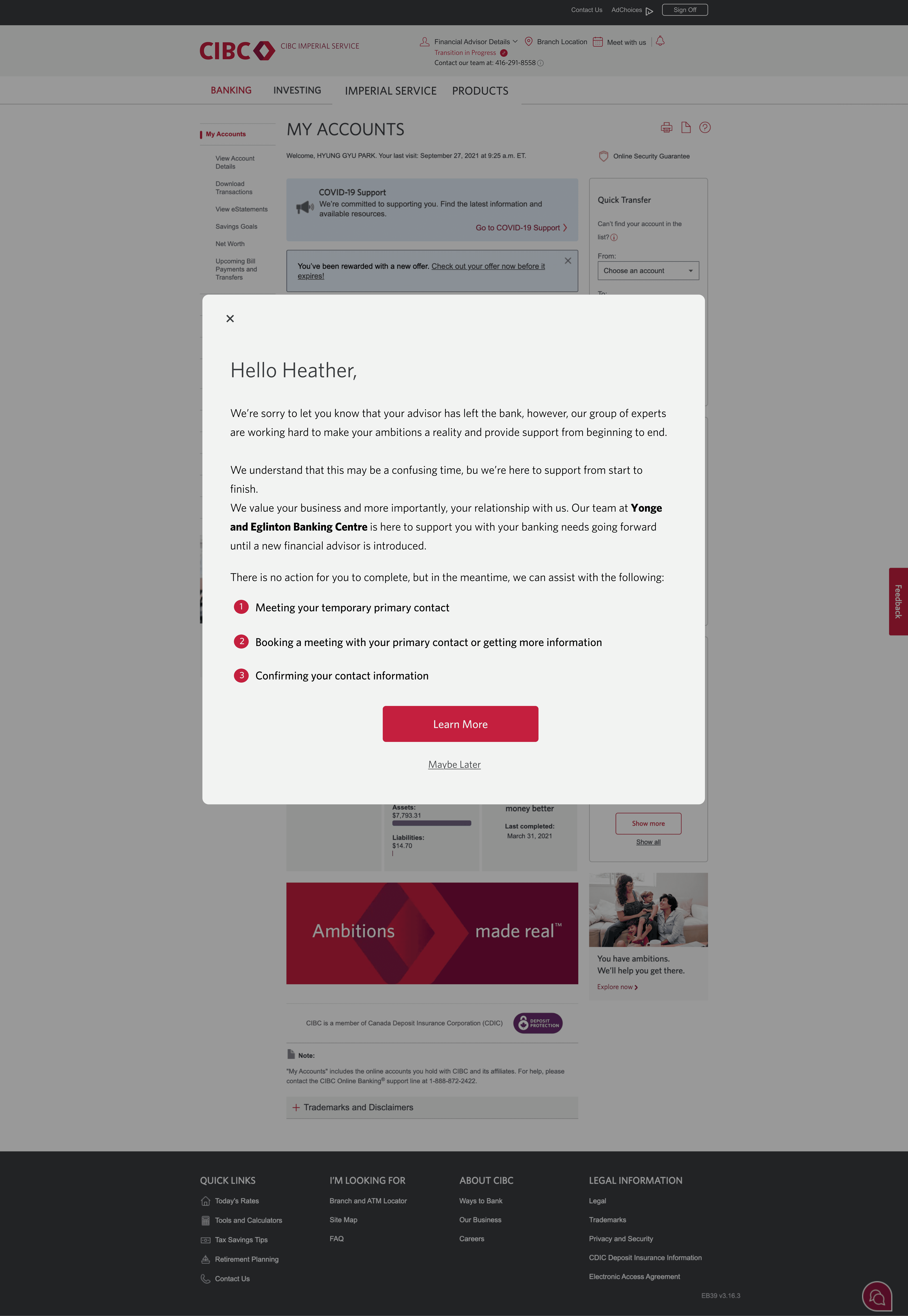
01 Initial notification modal
Clarity & Ownership
Once they click to "Learn More", they are immediately notified of who their primary contact is from the home branch and are also provided contact information of FCG, the group that is currently handling their portfolio.
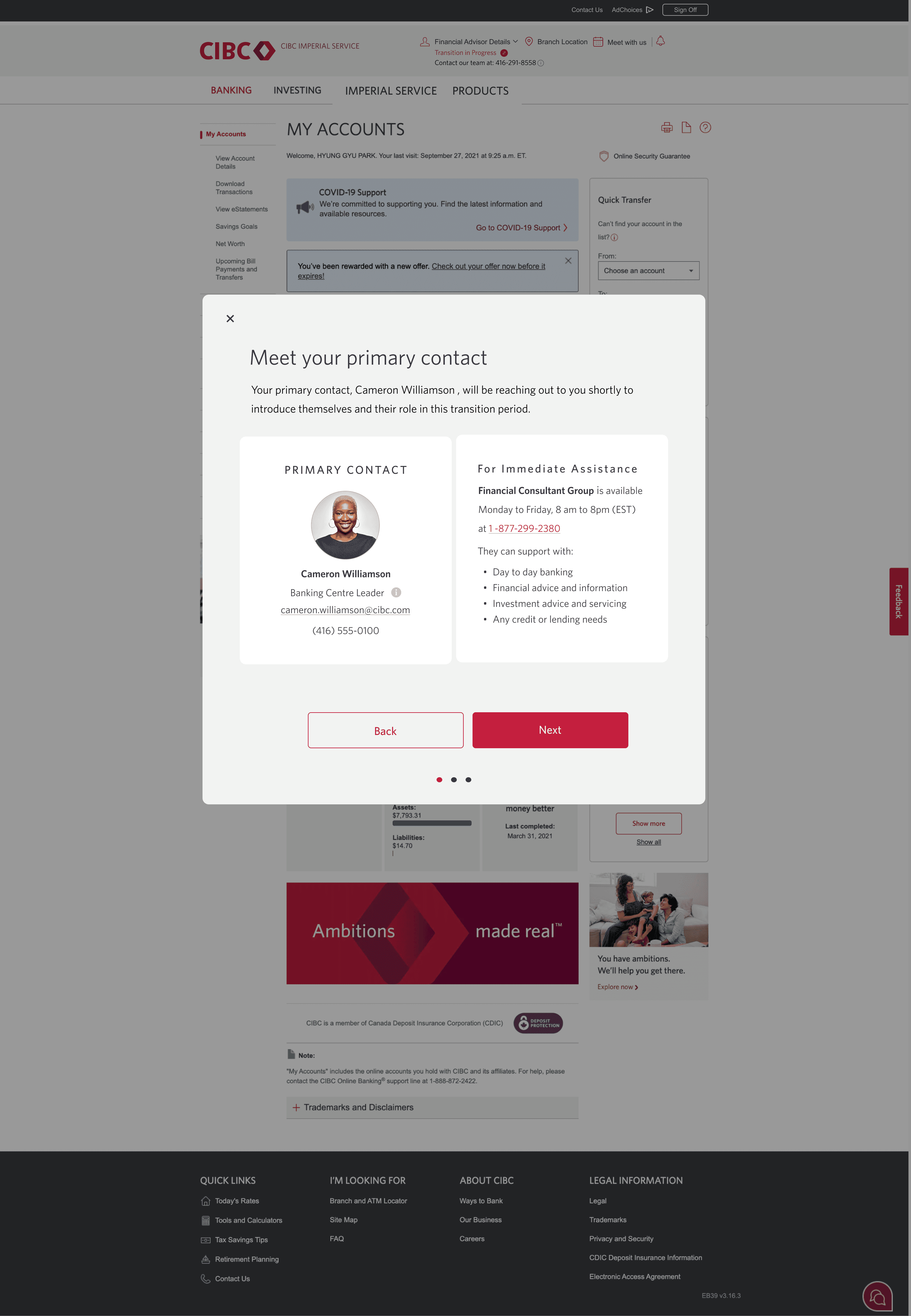
02 Meet your primary contact
Action & Control
Once they click to "Learn More", they are immediately notified of who their primary contact is from the home branch and are also provided contact information of FCG, the group that is currently handling their portfolio.
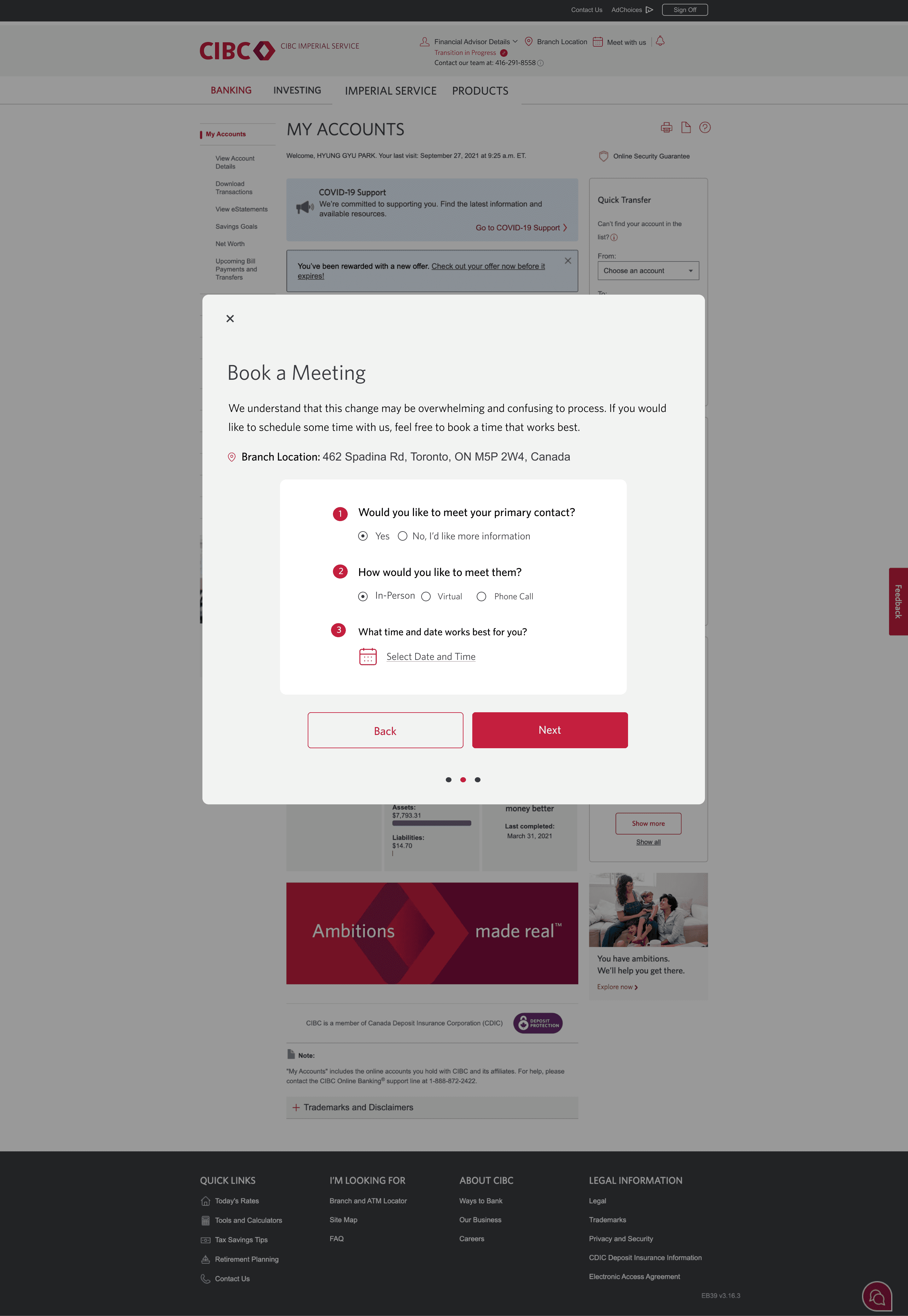
03 Book a meeting
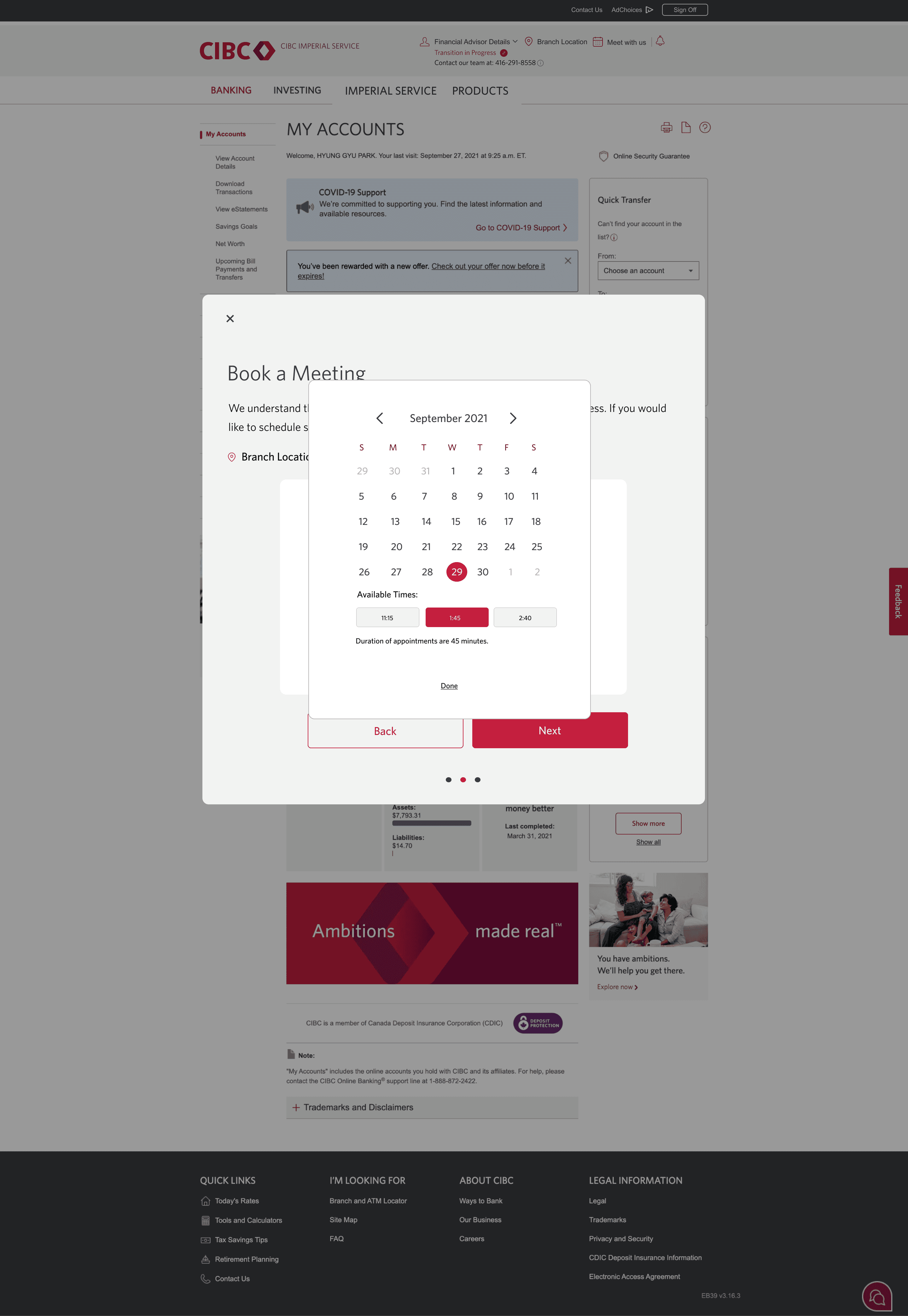
04 Calendar selection
Confirmation
Heather and Rick are then able to confirm their contact details so that their records are consistent within CIBC databases. At the end of this experience, the client is able to review the details: primary contact's information, meeting details and their contact information.
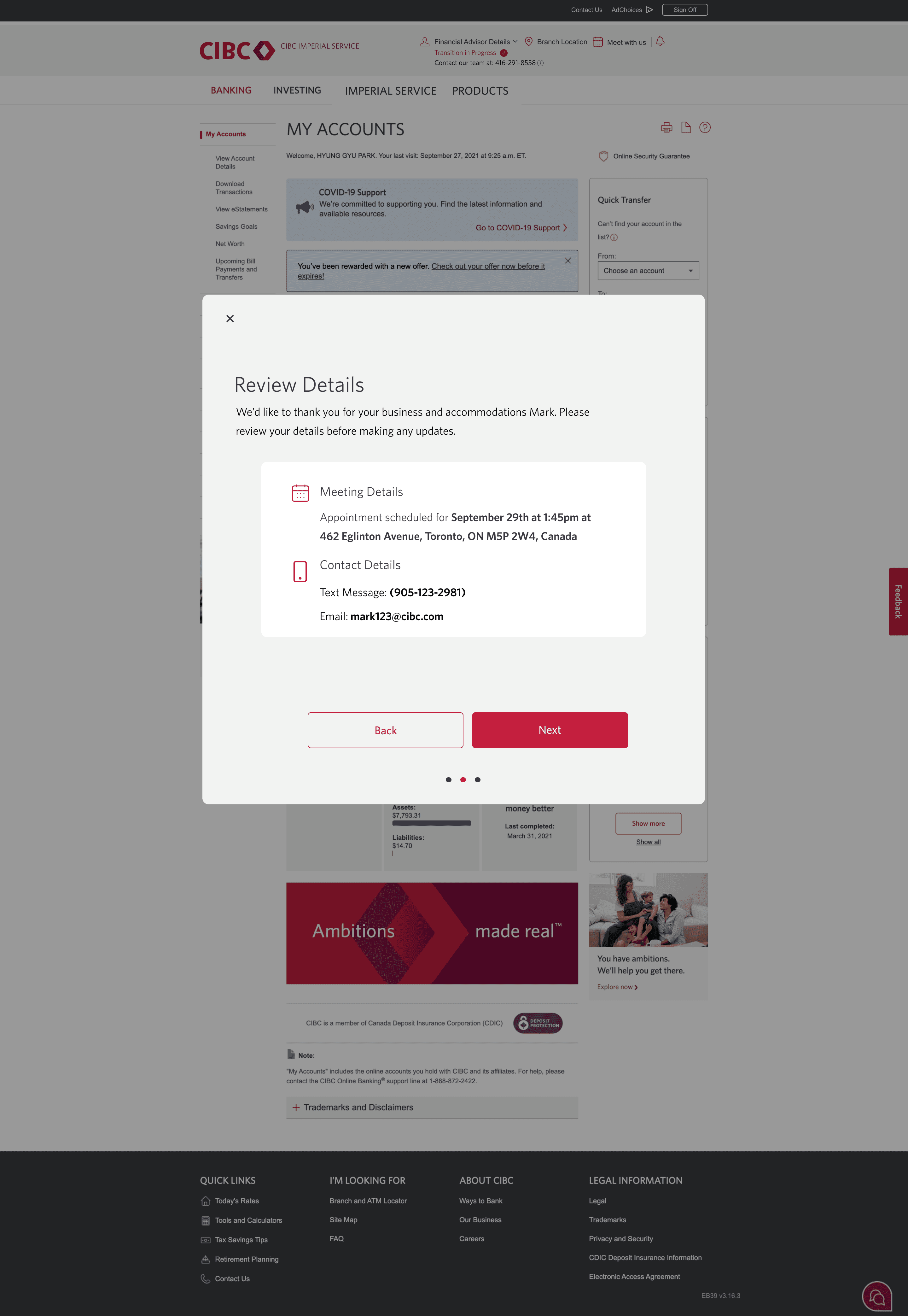
05 Meeting date confirmed
Multi-Channel Strategy
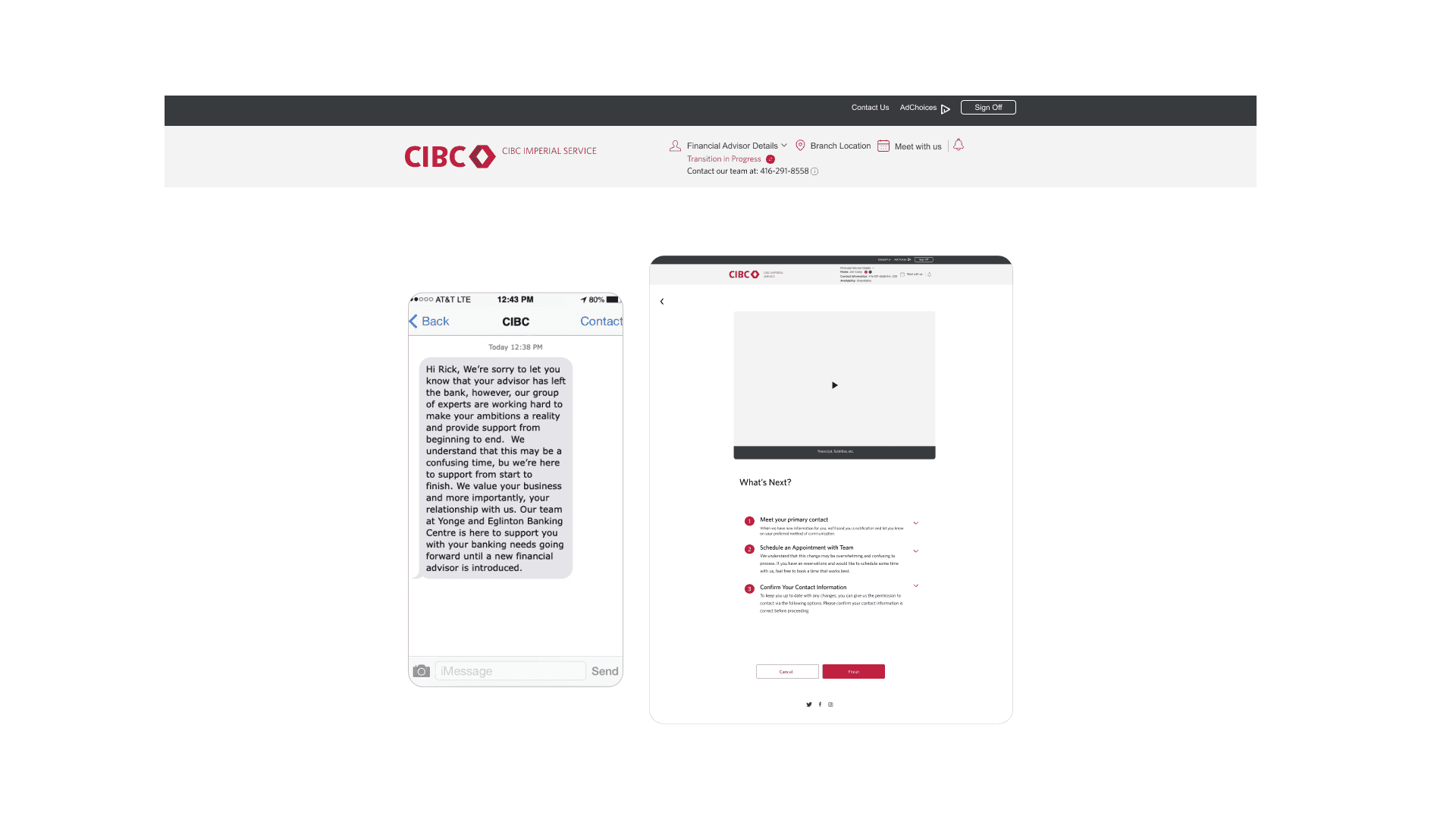
Beyond this experience, we are introducing more ways to communicate. Clients can receive this messaging through text message, push notification, our FAQ forums and our public site CIBC.com.
Ultimately, these communication channels and methods can funnel into online banking—and online banking can be used as the primary home for the message we are trying to give.
Push Notifications
SMS
FAQ Forums
CIBC.com
Online Banking
Success Metrics
Defining Success
As a sprint-based concept, success was framed around qualitative and behavioral indicators:
Reduced client confusion during advisor transitions
Increased engagement with digital banking during transition periods
Faster connection between clients and new advisors
Improved trust and retention signals following transitions
Key Learnings
What I Went Away With
For me, it established the importance of designing for emotion, communication, and systems—not just screens.
01
Trust is most fragile during moments of change
02
Communication design is a core UX responsibility
03
Personas must include internal stakeholders in enterprise contexts
04
Human-centered frameworks scale even in large institutions
additional work
explore more
Enquiries
social
© ilelosa eguavoen 2026